Dolfan Radio Essay
By Brad Michaels • August 29, 2026
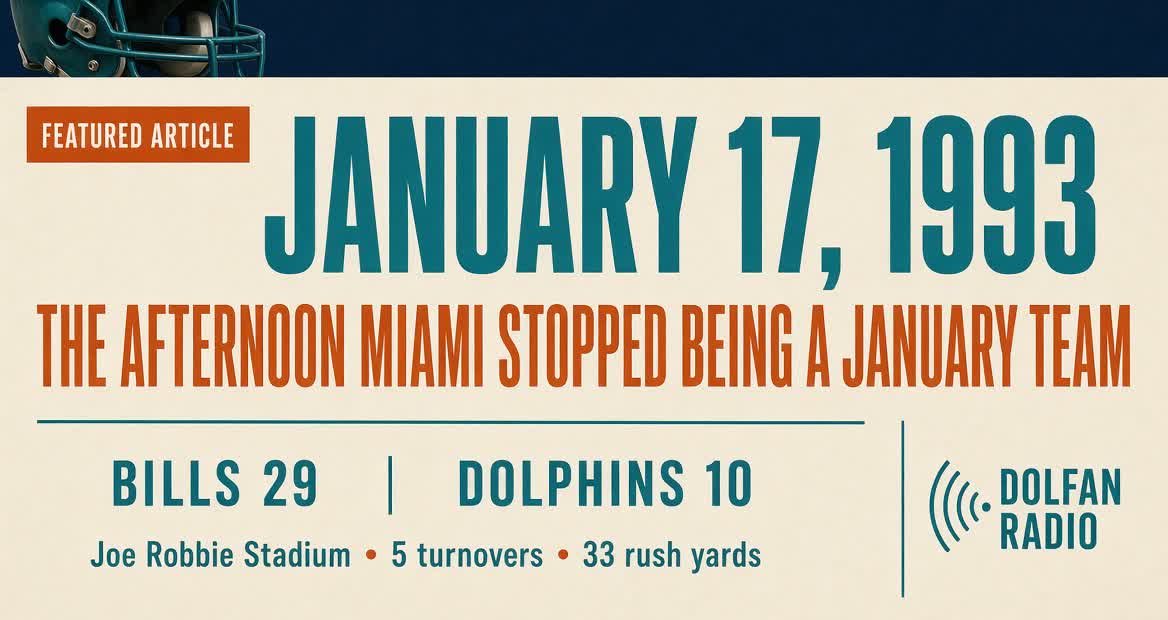
The 1993 Bills game showed Miami could no longer win in January. After 1995, ownership stopped waiting for Shula to fix it. Every coach since has been hired to solve a problem that started that afternoon — and none of them have.
Joe Robbie Stadium. January 17, 1993. AFC Championship Game. Buffalo 29, Miami 10.
That is the last time the Miami Dolphins played for a Super Bowl berth. Thirty-three seasons later, the drought is tied with the Cleveland Browns for the longest conference-title absence in the NFL. Miami also owns a second, uglier record: the league’s longest playoff-win drought. The last postseason victory was a wild-card overtime over Indianapolis after the 2000 season. Two droughts. Same franchise. Same starting point.
This is not a curse story. It is a pattern.
The 1992 Dolphins were 11–5, AFC East champions, and coming off a 31–0 divisional shutout of San Diego. They hosted the Bills with Dan Marino, Mark Clayton, and Don Shula. On paper, it was a heavyweight fight. On the field, it was an audit.
Buffalo outrushed Miami 185 yards to 33. The Dolphins turned it over five times. Marino went 22-of-45 with two interceptions. Clayton dropped a touchdown that was in his hands. Marco Coleman let a stripped ball get through his hands. The second-half kickoff was fumbled. It was 20–3 before Miami had a chance to breathe. Steve Christie kicked five field goals. Thurman Thomas and Kenneth Davis ran the clock and the will out of the building.
Shula said afterward they were not ready for the big test. That sentence still holds.
The pass-first Dolphins got shoved around at home. That is the original sin of the last three decades: a team built to throw could not impose itself when January required a run game, ball security, and a short yard. The Bills did not sneak one. They exposed the ceiling.
Wayne Huizenga did not fire Shula the next morning. That matters. The 1993 loss was the on-field break, not the ownership break.
Shula coached three more seasons. None were losing seasons. None got Miami back to the door.
| Year | Record | Playoffs |
|---|---|---|
| 1993 | 9–7 | Missed (Marino torn Achilles) |
| 1994 | 10–6 | Won WC vs. Chiefs, lost Divisional at Chargers 22–21 |
| 1995 | 9–7 | Lost Wild Card at Buffalo 37–22 |
Competitive. Familiar. Not enough. The 1995 wild-card game in Buffalo was another physical beating. A few days later Shula met with Huizenga. On January 5, 1996, the winningest coach in NFL history stepped down. Huizenga offered an extension. Shula declined, citing one year left on the contract and the problem of restaffing. Within a week, Jimmy Johnson was the coach. Shula has always said the decision was his. The timeline still reads like a franchise that had already chosen its next act.
January 17, 1993 showed what Miami no longer was. January 1996 showed that ownership would not wait for Shula to find it again.
Johnson was the splash. Dallas toughness. University of Miami pedigree. The promise of a run game and an attitude. He went 36–28 in four seasons and 2–3 in the playoffs. He never got past the Divisional round. The losses got louder: 3–17 at New England, 3–38 at Denver, 7–62 at Jacksonville. The Dallas formula did not survive contact with Marino’s twilight or a roster that still could not finish January.
Dave Wannstedt inherited a good team and won the East in 2000. The Dolphins beat Peyton Manning’s Colts in overtime in the wild card. That is the last playoff win. The next week Oakland shut them out 27–0. Since then Miami has reached the postseason five more times — 2001, 2008, 2016, 2022, 2023 — and lost all five in the wild card.
Regular-season records after 1992, with postseason result. Source: team season logs compiled from Pro-Football-Reference and official season histories.
| Years | Coach | What happened |
|---|---|---|
| 1993–1995 | Don Shula | 28–20. Two playoff trips. Never back to the conference title game. |
| 1996–1999 | Jimmy Johnson | 36–28. Three playoff trips. None past the Divisional. Blowout exits. |
| 2000–2004 | Dave Wannstedt | Last playoff win (2000). Then the slide. Fired after a 1–8 start in 2004. |
| 2005–2026 | The carousel | Full-time: Saban, Cameron, Sparano, Philbin, Gase, Flores, McDaniel, Hafley. Interims: Jim Bates (2004), Todd Bowles (2011), Dan Campbell (2015). Five wild-card losses. No playoff wins in January. |
Plenty of 9–7 and 10–6 seasons hid the ceiling. The Patriots dynasty later turned the AFC East into a graveyard, but the drought started before Belichick. Buffalo in 1993 is the break. New England only made sure it lasted.
Three things stack. They start on that Sunday and they keep repeating.
1. The run game never got fixed. Thirty-three rushing yards in a championship game is not a box-score quirk. It is a philosophy failing a test. Johnson was hired to bring toughness. Hafley is talking physicality in 2026. Same sentence. Different decade.
2. Ownership chose a new coach over a finished identity. Huizenga did not pivot to Johnson in 1993. He pivoted after 1995. That is fair to the record. It is also the moment the franchise decided the answer was the next name on the door. Ten full-time coaches after Shula, plus three interims — Jim Bates (2004), Todd Bowles (2011), and Dan Campbell (2015). Every regime resets. None of them have taken Miami past the first weekend of January since Wannstedt’s last win.
3. Competitive football became the disguise. Dolfans know the feeling: good enough to believe in December, not built for the second week of January. Wild-card appearances without a punch. Talent spikes — Marino’s last years, the 2008 East title, the Hill-Waddle-Tua window — that died in the same round.
Jeff Hafley and Jon-Eric Sullivan are starting another reset. They are talking development, not standings. After an 0–3 preseason and a stripped roster, that is honest. It is also familiar. “We’ll be physical” is the sentence Miami has been trying to finish since Thurman Thomas ran through Joe Robbie.
The 1993 game did not curse the franchise. It diagnosed it. No run game. No ball security when it mattered. No answer when a better, tougher team showed up in their building. Shula had three more years and could not close the gap. After 1995, the franchise stopped waiting and started hiring. The hiring never stopped.
January 17, 1993 showed the ceiling. January 1996 changed who was allowed to chase it. Until Miami wins a playoff game — and then plays for a conference title again — every new coach is still answering that afternoon.
What do you think broke first: the run game, the patience, or the standard? Leave it in the comments.